Showing posts with label Zimbabwe. Show all posts

Saturday, 7 October 2017

My travel journal

How I dealt with burnout


I suffered from severe burnout for several months, felt I needed to step away from my surroundings a bit, but kept procrastinating. Slowly, everything started to get really loud and amplified, including the children. It took a concerted effort to not lash out, and smile instead, at my daughter when she was teasing and being playful. When my son got flappy, as he always does, I’d get into a complete tailspin. Work that I would normally accomplish in under an hour was now taking me three painful days.  There are times when I would sit by my computer to type and my mind would just be blank for hours. I could not even blog! I even thought of going to get a few tattoos, thinking it would help lift my mood. I knew I had to get away, and that also was a difficult decision to make because I don’t like being away from my children. We have a very strong bond. I realised, though, that I couldn’t be a good mum if I continued to stay and allow depression to set in.

I told myself I needed to go on holiday with just my little laptop, 750-piece jigsaw puzzle, bible, crafts, favourite books, walking shoes, dumbbells,  foot spa, yeah! It looked like it would be a glorious few days. I already had a destination in mind. Then I thought how lovely it would be to go and spend time with my parents who I hadn’t seen for 8 months. I’ve gone for longer durations without seeing them, but felt it would be great to see them when my attention wasn’t divided.

TRIP TO JOHANNESBURG

I boarded a shuttle from Manzini to OR Tambo International Airport. It was my first time to sleep comfortably along that route. During my other trips to Joburg I always force myself to keep my eyes peeled in order to keep them on my husband who has a fast foot. The highway is littered with shrines for people who lost their lives on it. Many more don’t have shrines. On the last trip before this one we had actually seen a man who had just been a few minutes ahead of us being covered by a foil sheet after losing his life. That traumatised me for a few days.

THE AIRPORT

A picture I took from the viewing deck
I had a Tom Hanks in The Terminal experience at OR Tambo. I arrived at 1pm for a 6pm flight, with nothing of substance to do. I looked around in vain for fancy stationery for my penpalling hobby, had a lousy meal at Nandos, then decided to go to the viewing deck to watch planes touch down and take off. I used to bring my son to the deck and he used to enjoy it. I decided I would also bring my daughter the next time I came to Joburg. How I missed my kids and wished I could have been with them for those hours before my flightL!
The airport staff appeared to be on go slow and by boarding time, I was still at the very back of a long and winding queue. I asked to jump the queue and many people understood until I got to a very obnoxious man. He said, with unwarranted vehemence, “No, we are all waiting to go somewhere so you can’t go ahead of us. Just wait for your turn!”  He placed suitcase on one side and his wife (who had a big frame on the other). Everybody just stared at him in disbelief, because it wasn’t as if he couldn’t see the crisis at hand or he would lose his seat by allowing others to rush for their flights. When he realised how much he had overreacted and how much attention he had drawn to his ridiculous self, he started gently chatting me up and tried to explain how my plane would wait for me. I wasn’t even listening to him. When my turn came, how I tore down to the boarding gate, which appeared like kilometres away. It was my first time flying with Air Zimbabwe and had a very negative perception of them. I was convinced they would just take off without me, and without batting an eyelid. Thankfully the flight was delayed by more than 30 minutes. I had never been so delighted about a delay in my life!

HARARE

Harare has become so hostile and aggressive. If you are used to, or prefer things being orderly like myself, you will surely lose your mind. However, home is home and I was truly happy to be there. My friend picked me from the airport and as soon as I set foot outside the airport, I felt like kneeling and kissing the ground like the Pope. I just felt free, like I’d been carrying a house all along.
The Zimbabwe Republic Police are now like marauding lions on the streets, armed with their spikes and baton sticks. Police presence is supposed to instill a sense of security but I couldn’t help feeling like my life was threatened every time I saw a police officer. They are everywhere you don’t want them to be and nowhere near where you need them.  When I went to the 4th Street informal terminus to board a bus to Rusape, touts that appeared to be high on something would descend on potential passengers like a pack of jackals and starting pulling them in different directions. There is also cheap illicit liquor available on the street and touts types must be the target market. Everyone in Harare knows about the atrocities being committed at 4th Street terminus. People want to avoid it like the plague. I even saw a tout take money from a woman’s handbag as other touts pulled her in all directions. All the tugging might look like a competition for customers, but I suspect it’s actually a gimmick to pickpocket. Surprisingly, or not, there is never one of the thugs in uniform in sight. They’re all out there bullying and fleecing off motorists. A few days after my return to Swaziland, I heard that an old man died after an attack by the touts at 4th Street.

THE POVERTY

I was last home in January, and it was sad to see how much things had deteriorated L in that short space of time. It appears everyone has been reduced to a vendor, and there’s barely any space left on pavements for people to walk because that’s where vendors display their wares.  The vendors and their carts have also overspilled onto the road. Their presence appears so natural like they have always been there, like their carts have every right to take half the road.
Vendors in Harare
On my way to Rusape, a deaf man got on the bus and gave people a paper with his credentials endorsed by a disability organisation to read and give him alms. I simply shook my head without even reading the paper because he reeked of alcohol. I found it quite disrespectful that he would go and splurge people’s hard-earned cash on alcohol, then come back to ask for more. He showed me a coin, indicating that’s all he was asking for. I shook my head again and his face displayed murderous rage.
It is a common occurrence for beggars to bum a ride on public transport, collect some change, get off on one station, and find another bus to continue the cycle. No sooner than the first beggar has alighted than the next one gets on the bus and starts singing pitiful church hymns that tug at your heartstrings and make you want to dig deep into your pockets. However, even if you are a compassionate passenger, there are instances when you have to tighten your fists. It’s impossible to save everyone. On my way to Harare an emaciated man also got on the bus, and a few minutes out of Rusape, he stood up and started narrating how he had been a bus driver but had had to quit working after he was diagnosed with cancer. He asked for money to be able to feed his family and moved from the front of the bus to the back with an open palm, collecting coins. He even gave out his phone number, citing that he was aware of the cash crisis so those without hard cash could do mobile transfers. There I was sitting with my sunglasses and bright lipstick. When he got to me, he must have thought he had hit the jackpot because he lifted the leg of his trousers and announced, “Honaiwo zvakaita gumbo rangu izvi,” (Look at what has become of my leg.)  I quickly closed my eyes inside the sunglasses and never saw a thing. While I understood his plight, I didn’t think it was necessary for him to shock people into donating. I actually thought it was unfair and a little aggressive.

HOME IS WHERE THE LOVE IS

One of the sausage and cheese eating dogs, Rusty
While standing somewhere with my two friends, a kombi which was parked near us wouldn’t start. Two men that were in it requested a push. My friends laughed at their audacity to ask ladies for a push, but the men were really desperate. I said, “Absolutely!” and helped push the vehicle. They managed to drive off. My friends were laughing at me and I didn’t care. I was just so happy to be home I didn’t know what to do with myself. 
I was surrounded by so much love from my parents, friends, and total strangers, I felt like singing, “Love is all around me” by Wet Wet Wet. I wished I had a huge jar to can all that love to then take in small doses upon my return to the lacklustre life here.  One woman I sat next to on the bus bought about 20 mint sweets. She gave me 10. I was surprised because I’m not used to such gestures from strangers. When I reached my destination and she was still proceeding, I remembered to say thank you again for the sweets. There was never a dull day for a whole week. Friends visited, I visited some and treasured every moment, though I unfortunately had to come back without seeing some people I would have loved to see too because of limited time. Even my parents’ big dogs went crazy with joy when they saw me. They are heavy, yet they like standing on their two legs for hugs. One can easily fall from their weight. They eat lots of meat, sausages, cheese, and all the good food you can think off. My father heads out to OK supermarket every morning around 6 to collect leftovers from the restaurant. He had many stories to tell about the people that he meets there while queuing for dog food. Some of the people actually take the food home to eat. There was also talk of stray cats also hovering for the same.
My parents and friends overfed me! There was always good food being sourced every day and I couldn’t say no.
My father makes the best Maputi nzungu combo ever!
They would have been offended and I also didn’t want to miss out on food that wasn’t readily available in Swaziland. I ate magogoya, maputi, mawuyu, masawu, and drank maheu. I even managed to smuggle all those things and more back to Swaziland for my family. My special diet went out the window. My friends took me out and I ate everything I wasn’t supposed to eat. When they were done feeding me, they gave me gifts. I got lots of homemade peanut butter from a childhood friend and a cutlery set from another. People were tripping over themselves trying to make me happy, and I lapped it all up!  I possibly gained two or more kilogrammes in one week, but it would have been worth it. I didn’t weigh myself upon returning because I wasn’t going to allow a scale to ruin my precious moments at home. I do hope that one day I will also be able to treat my friends as they treated me.  I didn’t even tell them about the burnout I’d suffered but they somehow just 
managed to help get rid of it. A holiday at a resort would not have made me feel as good as those people made me.For a whole week I woke up late and did absolutely nothing but talk, eat, cook sometimes, and walk a little. It was lovely. When my parents spoke to me, I would listen attentively, knowing I’d miss these real conversations. It also was a window to their everyday life. I even swapped cross stitch patterns with my mom. When my week was up, I left home feeling rejuvenated and ready to trample snakes and scorpions. Air Zimbabwe allows 40kg baggage. I had about 45kgs of treats I wouldn’t find in Swaziland. Fortunately I got to the airport early and was able to weigh my luggage well in advance of check-in. I shoved the excess 5kg into my large handbag and felt like my own hero! 


Saturday, 20 February 2016

El Nino effect in pictures


The way I now anticipate rains like a farmer!  To think that at some point when I was still dating, I hated it when it rained.  Then it would become difficult to justify walking out into the rain “to see a friend”. My strict parents would say, “What friend would ask you to go out when it’s pouring like this?”

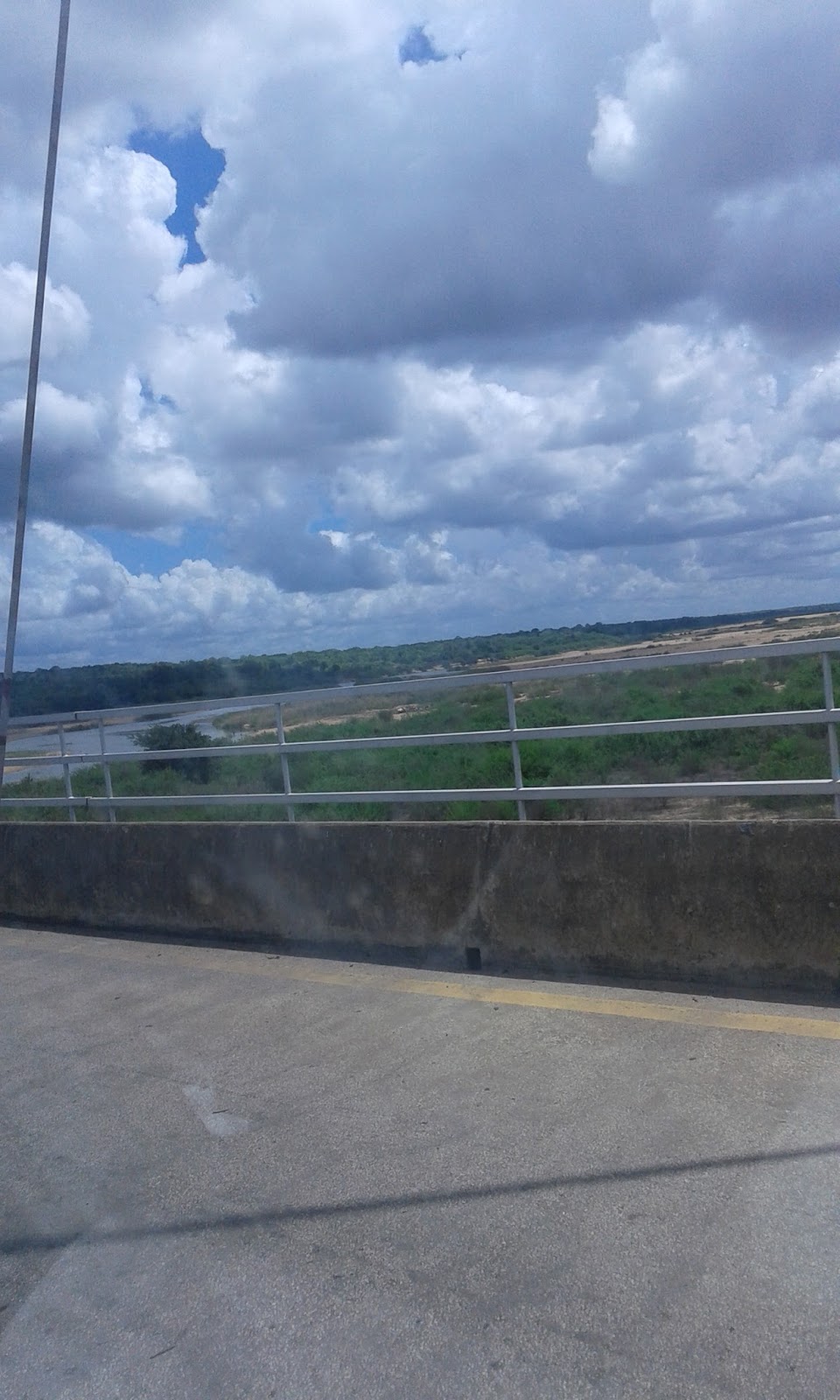
Never in my life have I been this hot. There was a day when I walked to the shops and felt as if my shoes were melting on my feet. Last year I had a bumper harvest of sorts from my little garden. This year the same garden has been a sorry sightL. The dams are an even sorrier sight. I managed to take a few hurried photos of dams and rivers in Swaziland, Mozambique and Zimbabwe.  How we will get through the year with so little water available is actually quite a scary prospect. Trees and grass are growing where dams used to exist. We just have to keep praying for the best. 


Save River in Mozambique

What used to be a river on the Chivhu-Beitbridge Road, Zimbabwe
Critically low water levels in Rusape Dam, Zimbabwe. All those rocks used to be submerged at some point
That whole area my family is walking on was the centre of the Rusape dam


All the four pictures above represent my "bumper harvest" from my garden last year. J


We enjoyed many meals like this one a lot last year, the green is pumpkin leaves, a family favourite

How the garden looked this year :'(


This was all we harvested this year

The grave issue surrounding repatriation

Because of the current fiscal crisis in Zimbabwe, millions of people have moved to greener pastures all over the globe. Those who have migrated to other countries have done a great job keeping the wolf from their families’ doors by sending back money for sustenance. Many of these people, particularly those in the West, spend many years without coming back home because it’s probably too expensive for them to do so, or they haven’t regularized their papers to enable them to be accepted back after the visit to Zimbabwe. I know people who left for the UK decades ago and have never come back home, not even for their parents’ funerals. They start their own families with people their parents have never met or might never meet, and just connect with their families over the phone and via social media. I’m not very far from home but my visits there are very few and far between, and when I make them, they are very frenzied because there are many people to see in so little time. I can’t begin to imagine how it must be to never visit your birth country.

Like everybody else, people in the diaspora die. I’ve witnessed many very sad events when families just wake up to the news that one of their own has died in the UK. People get into a tailspin wondering where to start, where to get money to repatriate the body of their loved one. Culturally, people believe everyone should be buried close to their ancestors, and anyone buried in foreign lands is deemed to have been “thrown away”. Should calamity strike the family at some point after the foreign burial, they start fearing that it’s the deceased’s spirit which is anguished for not being buried in the land of their fathers.   Some have been lucky to have their deceased relatives’ friends and colleagues fundraise for repatriation. Others sadly just grieve at home and have to contend with pictures of the funeral sent by well-wishers.
I don’t really think where someone is buried has bearing on life afterwards. It’s not like they are bringing you to sit at the dinner table with them. They are still going to throw you away. I do understand, however, that after not seeing a family member for decades, then you’re told they have passed, you might want to see their remains, hold a vigil for them, sing and dance the whole night, witness their burial with your own two eyes, and be able to visit the grave to place flowers before you can get closure. It’s particularly harder for the older generation. They will hold family meetings and declare that there’s no way their child will be buried in a foreign land. Then they chill and wait for others to cough up because all they have is their wish for their child to come home, no two cents to rub together whatsoever.
Some of my friends in the diaspora told me that they don’t mind being buried where they are, and think all the money spent on repatriation is a waste. Unfortunately they haven’t expressed their sentiments to their families, who will insist on bringing them home. I think the decision to be buried abroad should be communicated well in advance so that people can explain themselves to their families, and people can make peace with it. It can be infuriating for the extended family when meetings are held following a death, whatsapp groups are formed with their names forcibly added,  and coercion is used to make people contribute for the transportation of the deceased’s remains. In their off-shoot clusters people will jabber about how the deceased used to be a picture of success on Facebook, going to holidays and stuff, and even bought iPhones and cars and built houses for his parents. Why didn’t he have the presence of mind to invest in a repatriation policy?
Among the most difficult things to discuss in life are funeral plans. We do not like to harbour morbid thoughts. We have so much to live for – our jobs, families, friends, and life in general. Thinking or talking about our mortality is like throwing a wet blanket on a roaring fire. Some people are only concerned with immediate consumption and believing “tomorrow will take care of itself,” which couldn’t be further from the truth. Tomorrow never takes care of itself, you have to take care of it. But we all know that death is certain and we should make plans for it while we still can.
Avoiding certain conversations usually results in people being caught flat-footed and struggling with issues that would have been very easy to handle had they been managed appropriately. We need to talk to our families about where want to be buried or if we choose cremation, what would we want done with the ashes, what do we want done on our memorial services, things like that. It won’t be an easy conversation because the red flag always goes up in people’s heads when you start discussing details of your funeral. They associate that with suicidal tendencies.
Repatriating a body, especially one of an uninsured person can be a long and wearisome experience, particularly for those already reeling from the loss. It is fraught with a lot of paperwork, expenses and bureaucratic procedures that will send one into a tizzy. If you are in the diaspora, have that conversation with your family.

Below is what my friends think about repatriation:

Patricia*(UK)
I choose to be buried here where my kids are and will visit me daily if they wish to.
Martha* (UK)
I don’t want my body back to Zimbabwe. I’d rather the money be used on my child to pay school fees. I will be dead so no big deal. If my siblings have the money, they can repatriate. I feel it’s a waste. It’s better to use the money to travel to England, be on a plane for some of them for the first time and do the funeral. I’d rather get life, than funeral assurance. Families just need to be told that it costs an arm and a leg to repatriate a body from abroad. Even if you tell them your wish, people will just disregard it when you die.

Harriet*(US)

We buried my dad here, partly because our whole family was here and we thought it was better to bury him where we would be able to visit his grave easily, but partly because repatriation was $10 000 and we had just arrived here and didn’t have the money. My relatives were not ok with our decision but they were not willing to come up with the money which we asked them to do.  When I was in Uganda I always told my family, “Don’t go to the expense of taking my body to Zimbabwe. Cremate me and take the ashes.” 

*names changed

Sunday, 14 February 2016

My father's grapevine

My father's grape vine
When I went to Zimbabwe for the holidays, I had a list of things I planned enjoying upon hitting home soil. I looked forward to enjoying peanut butter from Zimbabwe, especially the homemade stuff. You will never get anything better anywhere else. I also wanted my kids to enjoy the popular cereal, Cerevita, which I think should be ranked among the best cereals in the world. Matemba and mufushwa* were also up there on my wish list. But more than anything else, I hoped the grapes in my father’s little vineyard would be ripe in time for my visit.  
A plate of sadza, covo and matemba
That little vineyard was always his pride and joy, and he jealously protected it as he did us, his kids, and his dogs. We were not allowed anywhere near the grapes until they had become dark purple, or nearly black. If anyone stole a bunch, my father would know. It was as if he had counted all the clusters and knew them by name. No-one could come between my father and his grapes. It was always a sad day if a visitor came and headed straight for the grapes and started plucking the few ripe ones when we hadn’t had a taste of them because my father would say, “Imbomirai anyatsoti tsvaa!” (Wait till they become quite dark).
When he felt the time was right, it would usually be an afternoon during the weekend, he would take a dish and pick the grapes himself and place them on the table. We would all swarm up to the table and savour the bitter sweet dark grapes that we would have spent our whole lives waiting for. There are grapes in Swaziland, all varieties, but I just could not wait to get my hands on my father’s. They have their own unique taste, and I guess I just wanted to eat them because having to wait for them so many times made them really special.
In 2001, it was the same story of waiting for the grapes until anyatsoti tsvaa! They would usually be the right colour (in my father’s eyes) around late mid-February depending on how good the rains were, I guess. Unfortunately one of my favourite uncles, Aggrey, died at Rusape Hospital on the 20th of January. As is custom in the township, people flocked to our house to convey their condolences. The women traditionally sit inside the house where they sit on the floor, sing and chat in hushed tones. The men take the couches out of the house and find a shade to place them and they sit and chat as well. In this instance, they chose to see under the grape vine. So they sat, chatted, and devoured grapes. We went to Dowa for the funeral, and upon returning, discovered there was nothing to show that grapes ever grew on that vine. We were extremely sad – for the loss of our uncle and the disappearance of the grapes. We felt robbed. We were angry with our father and his adherence to dark grapes. We could have just enjoyed them even when they were semi-dark.
The grapes my father sent me 
Going back to when I visited home in 2015, sadly the grapes were still quite raw and green. A few times I saw my husband and my sister’s husband lurking under the grape tree, picking a few ripe ones and ruefully thought my father was growing soft. That was not allowed in our time and I didn’t even attempt to follow in their footsteps. I obeyed the rules. We left Rusape when the grapes were still green and I felt like there was a void in my heart. After many years away from home I was going to go without eating THE GRAPESL. While we were in Harare, my father called one morning and said he had sent something with the conductor of a kombi written ‘Sister Chido’ at the back and he also texted his number. (Public transport operators have become the chosen mode of sending money and packages across towns In Zimbabwe. Not only is this method quicker, it is also more reliable than the postal service which was always fraught with strikes, and in many cases, missing packages.)  We found the conductor and he gave us a shoe box wrapped in an OK carrier bag. With keen fingers, I unwrapped the gift, and lo and behold – dark grapes. I mentally punched the air with my fist and said, “This is what I’m talking about. This is coming home!”J
I’m sure my father had registered my sadness at going away without eating his grapes, even though I had not vocalized it. For him it was a small gesture, but for me it became a treasured memory, and that’s why it has found space on this page.

*Mufushwa is dried vegetables. They could be kale, cabbage, cowpeas leaves and other wild varieties. I prefer the wild ones and cowpeas leaves, which I boil and mix with peanut butter. Yum yum! 

Saturday, 30 January 2016

All about my recent visit to Zimbabwe

Reserve Bank of Zimbabwe entrance
I had a two-week visit to Zimbabwe during the festive season. I had last been there in 2013 and was looking forward to going back to be with family and be “home”. After this recent visit, I suddenly started believing that home is not necessarily where you were born and raised, or where your father, mother and siblings are. We should gladly embrace our host countries as real homes, and Zimbabwe as our first home, our other home.
I really did not feel at home this time around because commodity prices were way beyond what I thought was normal, especially for anyone carrying the South African Rand in their pockets, as we did. Many of my rand-earning friends cancelled their visits to Zimbabwe when the exchange rate against the US dollar fell to an extremely unfavourable 16:1. Others still went home, but shortened their stay after their pockets quickly became depleted. A can of baked beans, for instance, was close to a dollar, that means it was about R16 when converted, and a 2 litre of Coke was R32. We buy those commodities for about R6 and R18 respectively. It didn’t help that the usual Zimbabwean problems such as power-cuts and water shortages still persisted. I had huge adjustment problems because in Manzini we hardly have power-cuts or water shortages, although Mbabane is currently having serious water problems because of the drought and has started water-rationing.
The people with the longest faces, however, were most civil servants. They did not get their December salaries until January 5th and are still waiting for their bonuses. 
A week before we even left Swaziland, which was also a week before Christmas, I had been informed that there was no electricity at my parents’ house in Rusape where we were visiting first. A transformer was said to have exploded.  I assumed by the time we got there, things would have normalized, but alas… We stayed there for a week and never saw electricity once. A small section of the neighbourhood was affected, so we were able to charge our phones at my aunt’s house nearby. That’s also where we kept perishables. The other option was to also charge in the car. It was a hassle, and I usually didn’t even bother to charge my phone.
As they say, every cloud has silver lining. We actually were forced to have candlelit dinner every day J. Not having power in the house also meant there was no TV and there was minimal use of mobile phones. I thought we would have to go to bed at 7pm for lack of entertainment, but for the duration of that week, we slept at around midnight almost every day. There were so many stories to share, and I always prodded my father to talk about ghost stories. He always gets animated when he talks about ghosts, as he says there were many in Dowa, west of Rusape, were he grew up. Everyone, including myself, also had a story to tell. Read here for my ghost story.
Uncollected refuse at the Rusape Bus Rank
I had done my nails for the holidays but ended up breaking themL while carrying pots from the fire where we cooked into the house and from exposing them to the fire while pushing bits of wood into it. I got ash in my newly-done weave trying to blow the fire after it had rained and the wood was damp. Eventually we bought a gas stove. Power was only restored on January 2nd.
Now I hear there are fears of typhoid outbreak and that doesn’t surprise me at all. People just dispose of their refuse willy nilly. I hope the outbreak is quickly contained, because given the water crisis in the country, many people would surely perish from it. My sister has stayed in the low density suburb of Mandara for the past three years, and through all those years, has not seen a drop of water come out of her tap. Word on the street is that council decided those living in low density areas could afford to dig boreholes so they would not have water channeled to their houses. When we were in Mandara, we had to use water very sparingly and only took a bath from a bucket once a day. They have to buy 5000 litres of water for $50 and it lasts about 3 weeks. They also have to harvest water when it rains, and their pool has become another storage place for water to use for ablution purposes.
I enjoyed the communal way of life in Rusape, which I miss sometimes while I’m here. My parents’ neighbours lost a relative and one other neighbour called my mom from behind the durawall to inform her. As soon as my mom heard, she called her other neighbours from her sink behind the other side of the durawall to also spread the word. In less than five minutes of word of the death coming, many people knew. They immediately joined each other on the street and made way to the grieving neighbours to convey their condolences. That’s how it has always happened even when I was growing up. News spread like veld fire in the township. It would get really hectic if the news wasn’t so positive for your family, because it spread faster than the funeral ones. Woe betide if your child got arrested or pregnant, or if your husband was sleeping with some known prostitute. Everyone would know and talk about it. Read here about life in the townships, as I know it.
Children playing on the street in Rusape
It was sad to note how, because of the economic quandary Zimbabwe is in, everyone has been reduced to a vendor. Everywhere you turn, somebody is selling something. The streets were lined with people peddling their wares ranging from vegetables, second-hand clothes, cheap products from Chinese shops, everything. They have even bought small loudspeakers to lure people to their merchandise, which results in so much noise. If you park your car or drive in town, you are mobbed by people who walk around selling small things like foot powder, air fresheners, Zimbabwe flags, pirated CDs and DVDs, and all sorts of things. Sometimes their efforts to make you buy are borderline harassment, but you have to keep telling yourself that life isn’t easy here and they are trying to send their children to school, pay their rents, and put food for on their tables. It’s heartbreaking. You feel really guilty when you decline to buy something from someone because you can see the determination to make a sale in their eyes, but you check yourself and have to keep repeating in your head, “I can’t buy from everyone. Someone else will buy even if I don’t.” I did buy a flag on the street for $3 and my husband negotiated from $5. Speaking of streets, the potholes on them have grown in magnitude, and it’s almost hilarious to see all cars from left and right driving at their very extreme side as they all try to avoid the middle of the road riddled with potholes almost as deep as bath tubs
Vending stalls in Mbare, Harare
Despite the semblance of poverty, there are also pockets of affluence all around. People are building big and beautiful houses while being overcharged for building material and services. Zimbabweans have amazing tenacity. Because they have become so used to being swindled, some of them have become spendthrift without even realizing it. People pay ridiculous amounts for something and you are just left flabbergasted. My friend says she’s struggling financially but bought a facial product for $29=R464! I would never buy anything that overpriced. The same product, when on special here, costs R116=$7.25, would you believe it!
Because everything is overpriced, many people have resorted to buying second-hand clothes and shoes, in some cases even underwear, which come in huge bales from Mozambican ports. I had a glimpse at the financial results of a well-known clothing brand and noticed how it had done very badly. I just assumed it was because people were now looking for cheaper options.
Notwithstanding all the challenges being faced at home, I’m still super proud to be called a Zimbabwean, I had a great time with loved ones and was able to recharge my batteries. I will keep praying for better days for Zimbabwe. They will surely come. God hasn’t, can’t have, forgotten us.
Read here for my traumatic trip back to Swaziland.


Anecdotes about township life

Recently some loved ones lost a sister, who was just discovered lying dead in her apartment. She had not complained of an ailment and didn’t do drugs or anything like that. The family was very distressed over what could have happened to her and pinned their hopes on results from the post mortem. Unfortunately the post mortem results were inconclusive, so the family will always wonder what happened to their loved one…
Commenting on this, one of my friends said, “That’s the UK for you, most anti-social country I have ever seen. And if you don’t network, might be a year or more before anyone even notices you are dead. If you are a casual worker, no one will raise the alarm that you’re missing. They will just think you got another job.” That is really quite sad. I was raised in a high density suburb, and a thing like that would never happen. Neighbours are always a stone’s throw away and always keep an eye on the goings-on next door. In my post All about my recent visit to Zimbabwe, I mentioned how communal life is in the area that I was raised. Neighbours actually talk to each other. You don’t get out of your gate and not meet one of the neighbours. If you are sick, they will know about it, because they will ask if you’re OK.
Children playing on the street in Rusape, Zimbabwe
Everybody knows everyone, including their occupation and denomination. Sometimes your occupation would be used as a surname. When I was a child, I remember there was Mbuya Ruredzo Mustawara (Gran Ruredzo the Watchtower. She was actually Jehovah’s Witness but people had their own way of addressing her.) Then there was Smart Mbavha (Smart the thief), and Lizzy Muhure (Lizzy the prostitute). There were times when we got first-time visitors. All they needed to do was get off the bus, approach the nearest vendor and ask if they knew were my family lived. They would immediately be pointed in the right direction. Try doing that at Bree or Manzini rank and you will immediately become laughing stock. Life in “the suburbs” is hostile.  I got new neighbours about five months ago and I don’t even know their faces. I just know their car, which I see driving past my house every day.
My friend Erica said she missed people just rocking up on your doorstep without making appointments, which is almost unheard of now among people of my generation. They expect their parents to let them know in advance that they plan to visit. A mere neighbour doesn’t stand a chance.
There was never a lack of entertainment in the township. News spread like veld fire in the township. It would get really hectic if the news wasn’t so positive for your family, because it spread faster than the funeral ones. If your child got arrested or pregnant, or if your husband was sleeping with some known prostitute, everyone would know. There were many occasions when our parents had to chase us into the house when a prostitute or mistress tore down the street in her birthday suit after being caught in the act by a livid wife who had just arrived from the rural areas. There were also fights between husbands and their wives. I remember our neighbours who always fought and before long the husband would run down the street like a bat out of hell, with the wife in hot pursuit.
Now everyone wants to move away from the high density suburbs because they think staying there is a sign that you have failed in life, you have stagnated. Townships, especially in Zimbabwe, are now associated with filth – inappropriate refuse disposal, rivulets of raw sewage, outbreaks of diarrhoea, noise, and overpopulation.  Back then, things were more orderly and cleaner.
Life was so much safer back then. Now you have to keep your eyes on your child because there sex predators always lurking in the shadows. My husband mentioned how we didn’t really need TV because children could play on the streets until they were dog-tired. Then in the evening they would sleep better than the kids we are raising now. Mine sometimes only fall asleep at 2330 hours!
This is what Ngoni, my friend, had to say about township life: I miss the Ubuntu, the camaraderie and the unity of people. Everyone knows each other, and when you've been away for long and go back home, the whole neighbourhood comes to see you. they want to see how you have changed, what you  would have brought, etc, but in all that curiosity and gossip they do do care about each other."
And care they do! When someone from the neighbourhood dies or loses a loved one, there are women who go around collecting mealie meal and monetary offerings to take to the grieving family. 
I could go on and on about the happenings in the townships and never finish the half of it. Life was good during my time there, and one would certainly not die all alone without anyone noticing for days.


Wednesday, 2 December 2015

Farewell Dr Vimbai Gukwe Chivaura

Dr Vimbai Gukwe Chivaura (picture sourced from the Internet)
I got word of Dr Chivaura’s passing from my friend, Greatman, and it was quite a shock since I hadn’t heard of his illness. Not that it would have been easy to hear of it given that I’m so far away from home.
I had a long-standing relationship with Dr Chivaura dating back to 1999 when I started my 1st year at the University of Zimbabwe (UZ) to the time that I produced a Current Affairs programme he participated in at the Zimbabwe Broadcasting Corporation. At UZ, as soon as people who had done literature learned I was going also going to take the subject, they would immediately start talking about Chivaura, saying things like, “Uchamuona hako, muchanzwirira!” and things like that. I eventually met him, and oh boy, did we get an earful! He was quite charismatic. He’s not the type of person you would forget easily. Following his passing, I was chatting to former classmates, and everyone still had something they remembered him saying, unlike some lecturers who we have to scratch heads for before we can remember something they said, or even their names. It is for this reason that I decided to write something in memory of Dr Vimbai Chivaura. I felt he couldn’t just go like that. Something has to be written. I know there will be quite a few obituaries in his name, many of them unwritten.
For the general Zimbabwean populace, Dr Chivaura’s claim to fame were his unapologetic views on the ruling Zanu PF, opposition MDC, and the land reform programme. I remember a day that he broached the land reform programme during a lecture. One guy said it would have been a good concept if it had been done systematically. “Systematically?” he asked, wide eyed. “If you had spent two weeks without eating sadza and it was suddenly presented to you, would you eat it systematically? Wouldn’t you just attack it?” he said.
Dr Chivaura never really stuck to formal lecturing. He liked chatting and picking people’s brains on topical issues. I don’t remember him for specific set books, but for his views and for prompting students to think critically about the world around them. During one of his lectures, he started talking about how fast men were becoming irrelevant in women’s lives. “In the West, penises are being sold over the counter. You just go and pick the one you want wonozvibaya zvako wega!” he said.
 He liked stimulating debate without really imposing his strong views on anyone. He stood his ground, you would never be left confused about how he felt about anything, yet he listened attentively to everyone’s point of view. The debates were almost on an equal footing. It is probably for this reason that students still loved him and liked to listen to his hilarious interpretation of the country’s issues. Many people are hated for their divergent views. It wasn’t usually the case with Dr Chivaura and his students, but he wasn’t loved too much on the streets by people who watched him on TV.
Without attempting to contaminate his memory, I will be honest and mention that Dr Chivaura was a bit of a flirt. At some point I needed help with my postgrad project and my co-coordinator referred me to Dr Chivaura. As I got into his office, he looked at me with his trademark smile and said, “Hauchionaka! Ndiwe chaiye musikana wandinoda kuendesa kuna amai vangu!” It was an awkward moment for me because I thought he was really old. And I was right! When he passed, I got to know that he was just a year my father’s junior. Another time, I had to see him again for the said project, and after the greetings, he said, “Chichema tinzwe ndigochemawo,” which for me was laden with innuendos. I don’t know if he was really hitting on me or was just enjoying playing with words as he was a poet, but it was a little weird for me. I didn’t take him seriously and he, fortunately, never said anything suggestive again.
Dr Chivaura was also quite a gossip. One day he saw me chatting to a friendly literature lecturer who people said was gay. He called me later and said, “I saw you talk to ******. Unoziva here kuti ingochani?” I must have mumbled something because I was horrified and wasn’t sure how to respond. He was undaunted and said, “Unoda kuziva here kuti ngochani yake ndiyani?” Before I could affirm my willingness to know, he came closer and hissed in my ear, “Ndi********!” Only Dr Chivaura would pull a stunt like that.
I remember meeting him near Zesa offices just after I had delivered my first child. He had seen me pregnant prior to that, so he said congratulations and went on to tell me he had also got a baby at around the same time as I delivered.  I was a little bewildered as I was of the opinion that he was at an age where he was supposed to be receiving grandchildren, not procreating. But who am I to tell people when to stop having babies? Right now, I just feel really sorry for that child he told me about, his siblings, and their mother. He must be close to 10 years of age now, and he just lost a father with a very strong personality. I was honoured to have come into contact with Dr Vimbai Chivaura, and I feel sorry for literature students at UZ who will just have to content with tales about him and not be able to meet this enigma. May his soul rest in eternal peace.

** names withheld because of the sensitivity of the allegations

Here is how some of my classmates remember him:

Greatman: Chivaura for me was one of the elite that pretended to be pro-African, yet their lifestyles spoke everything Western. He was obsessed with talking about African drums and stuff. I, however, liked his informal and casual approach to a lecture room situation.

Za: Chivaura was a character and a half. He said he was very proud to be a black man because black men, including himself, were handsome whichever way you looked at them. He was against the bible because he said it was the white man’s way of colonizing the black man’s mind. I clearly remember him challenging the authenticity of the biblical creation. He said that in the bible, it is written that when Cain slew Abel he was banished to the land of Nod, and when he got there he married. So he said, “And where did the land of Nod and its people come from since the first people were Adam and Eve, Cain’s parents?”


Ngoni: I enjoyed his lectures a lot. No student failed his course because he spent the whole period talking about Chennels and Musaemura, then towards the end he would just dish handouts. If you read the handout, that would be the exams kkk

Sunday, 4 May 2014

No holidays for Zimbabwean women


The Oxford Dictionary defines a holiday as:
1. an extended period of leisure and recreation, especially one spent away from home or travelling. 
2. A day of festivity or recreation when no work is done:

With this in mind, spare a thought for most married Zimbabwean women, for they know not the real meaning of this word. The Easter holidays have just ended, and many of these women are still nursing sore muscles after slaving away at their parents-in-laws houses. Real holidays are for rich, white tourists as far as most Zimbabwean men are concerned. Any public holiday is an excuse for them to show their parents that they got them a real beast of burden disguised as a wife. While holidays are a time to let your hair down and put your feet up, for a Zimbabwean daughter-in-law it's a time to tie your hair in your doek, place your feet firmly on the ground and work like a flogged horse. 

A survey I carried out with a number of married women indicated that beneath the submission and still waters, there's boiling rage and bitterness out there. Zimbabwean womenfolk feel short-changed by their husbands as they feel that their holidays are stolen from them. Many are lucky to ever spend a few hours of any holiday with their own parents.

I simply asked these women in my circle if they enjoyed their public holidays and Oh my! Did I open a can of big fat worms! From gangsta husbands who ban their wives families from visiting to sadistic ones that imprison their wives in their parents' houses behind invisible bars with invisible guns pointed at the woman's head, wives that come dressed as sheep but are actually wolves. In-laws who act like outlaws, husbands that think their families should be the only ones that should should get groceries and financial assistance. Because of the overwhelming response, I will have to write a follow-up article.
The worst affected seem to be the ones in the diaspora who only get to visit their families once a year, or even once in two years. 

According to Fatima: 
"Visiting in-laws is not fun at all because when the African daughter-in-law is there, the whole burden of household chores falls on her. I don't get enough time to relax. If I want a good holiday I just avoid visiting my husband's family. I enjoy going to my family for holidays because I get lots of help in whatever I need to do. I am more relaxed. I wake up late and eat what I want when I want. The other tactic is to have your own home in Zim especially closer to wherever they stay so that you can always relax there. African women have not holidays."
Tendai said:


 "Truly speaking, each time we visit Zim, I always feel short-changed because most time is dedicated to the husband's family.Fine, at times he leaves me at my father's house, which l strongly feel would just be some gimmick, because while at our home l get calls  from him any time to be told we have to visit this , that or the other person, all from his side.I basically have no time of my own. I'm not happy at all, and worse still when we go to his parents' house coming from South Africa, yooooh I will be so tired of travelling, and being a daughter-in-law, they expect you to cook for them from day one."
Because the issue of visiting families back home is such a thorny one, with many couples failing to strike a compromise, a lot of people have just decided not to visit their motherland during public holidays, and if they do, they minimise their stay there to minimise the squabbles. All the happy faces people see seem to be just a front. There is a lot of pressure behind the scenes. My former schoolmate, Ashley, had a lot to say with regards to home visits: 
"To manage all this craziness, we start planning for the journeys months before they come.  Budgeting every cent that it takes care of both families during the visit. We also set the number of days we spend with families which are not more than a week, that way it reduces pressure. Basically visiting family during holidays has become the biggest challenge we have had to encounter, it's not a joyous thing anymore because with each and every visit we plan, we have also to keep in mind the pressures we will encounter. We play the roles that need to be played and make sure we are out of there before we end up fighting ourselves because the pressure, when it's turned on from all corners, we ourselves end up fighting. 
To remove this pressure associated with visiting families in Zimbabwe, some couples part ways on arrival on the home soil. Georgina said she and her husband always part ways with her going to her mother's house while he goes to his own family. That way everyone is happy. It's a strategy that many couples have employed. Husband and wives then take time to visit each other' families, but will keep their bases at their families' homes. This seemed to be a popular choice for a lot of women I spoke to. Some open minded men, like Sam, did not find a problem with this.
"Normally we save for and make a single 'Home trip' each year where we include both families, days at mine and some at my wife's. If there is need or time is limited then we split, she goes to her family and I go to mine. We obviously not happy with the status quo but we have to do what we can, considering the expense and the work pressures this side." 
Austin confessed to spending more time with his family than his wife's.
"The reason is simply they stay in the rural areas and I am not comfortable staying in the rural areas as a typical town boy!Moreover I hate having to humble myself around the place, that's not my style!Definitely my wife is not happy about that because she wants more time checking out my in-laws. So what we do these days is shorten our stay in Zim to about a week!"
Lucky fish, isn't he just! It really is a man's world. A woman wouldn't have the audacity to say I can't visit my husband's family in the rural areas because I'm a typical town girl.

Of course, you can count on it that there will always be the hard nuts, which are the dominant group in the male species, like Ryan, who thinks that since he paid lobola for his wife, she's now like part of his furniture and can't just go to her family any more. Ryan said it's the wife that joins a man's family when they get married, she even assumes his surname, and that means she doesn't belong to her family anymore.


It seems the line between marriage and slavery is notoriously thin, in most cases. And here I was, thinking marriage was the merging of families, not the woman being forcibly yanked from her family. Talk about taking the wedding vow "To have and to hold (to ransom)" to another level! I also thought that if a woman got married, her parents would have gained a son not completely lost their daughter, condemned to never see her again. With this very bleak outlook of marriage, a nunnery begins to look like a very attractive option. Marriage shouldn't be for the benefit of one person, ensuring happiness for the other person should be reciprocal in that union.

People spend years on end away from their families, some only travel every second year to see their families in Zimbabwe. Both husband and wife miss their parents and relatives. They get home after so long and the husband says, "my parents'  home is now your home. You can't go to your family. I paid lobola for you. You even use my surname. Blah blah blah!" The woman misses her family while in the UK or wherever, comes to Zimbabwe and is forced to stay with people that her husband misses, is only permitted to see her family for a few hours and has to quickly take lots of pictures of them to see while she's imprisoned at the husband's family home, and before long is back in the diaspora, still missing her family. If this isn't sadistic, I don't know what is.  

"My husband has become self involved and there was a time when he didn't like my family to visit or us visiting them so it was a challenge. We have now always tried to balance the visits by alternating each year. Its not easy though as the hubby's family believe all holiday visits belong to them!", said Charity. "I sometimes catch myself asking me this question, is this all there is to life? To love? To marriage?" she added.

It appears, apart from women just missing being with their families, they are concerned about the high expectations that come from their husbands' families. "Most times you would rather spend more time with your family because your husband's family always has high expectations of you whether materialistic or physical, like cooking all the time," said Patricia. "Its never easy because nobody except your own family can really accept you. Its always easier with your own people. There is always that feeling that you are not welcome, even if its just imagination," she added. 
For some women, though, life is a breeze. One woman, Selinah, said, "Fortunately for me all my in-laws are deceased so I get to visit my family the most". Another, Elizabeth, said she was OK with her husband's family. "Maybe its easier because both my in-laws are late so I don't have to perform all the chores expected of a daughter-in-law."

I must say Selinah and Elizabeth's responses were jaw-dropping for me.They stopped me dead in my tracks. I had never thought someone's death could be viewed as fortunate. And it is disturbing that life turns out to be easy for some people only after others are dead! When will this war, this animosity between in-laws end? Can't we just get along when we are all alive? Does one have to die for the others to be happy?

There are a few drops in the ocean that actually get along with their living mothers-in-laws, like Anna:


"My husband's family is extremely big. When I go there I know I go to work , but my mother-in-law never sits down. We work together. She's a wonderful person and even shouts at her daughters when they don't help me with the chores . My husband and I agree on the duration of our stays with our respective families. My hubby is so free at my parents' house that he can sleep over even when I'm not with him. My sisters-in-law used to be a problem but my husband told them where to get off. My father-in-law is also a great man.
Anna's scenario is what a lot of women can only dream about.  

One interviewee gave me a very rare scenario where her father would pick her from the airport on her arrival from the UK and drop her off at her in-laws, saying she didn't belong to her biological family anymore.  

"Now my siblings are married I'm not forced to go to in-laws I just go to my siblings' houses and stay as much as I want," said Debrah.  

And that ladies and gentlemen, is the life of most Zimbabwean women with regards to public holidays. From these few interviews, there are evidently very few happy bunnies. In my follow-up blog, I will throw another pity party as we look at more of these very sad women's sob stories.

*Names of interviewees have been changed to ensure the women's families aren't slaughtered altogether so they are never seen again, not even on Facebook!